











Discovering Kanji: Seeing Language as Well as Hearing It
Preschool
October 9, 2017
Although CGK is an international preschool, our program also includes Japanese, with opportunities to encounter kanji as well as hiragana.
Rather than asking children to read hiragana and kanji, we write dates, names and other familiar words and show them to the children to spark their interest.
One idea behind this approach is that kanji have meaning, content, shape and sound, which can make them easier for young children to picture.
At the time of this lesson, our three-year-old class was encountering familiar kanji for dates, days of the week, weather (sun, cloud, rain, wind, snow and thunder), seasons (spring, summer, autumn and winter) and daily activities (books, songs and changing clothes).
Some of these characters are more complex than those taught in the first year of elementary school. Yet the children quickly remembered them because the words were familiar and interesting to them.
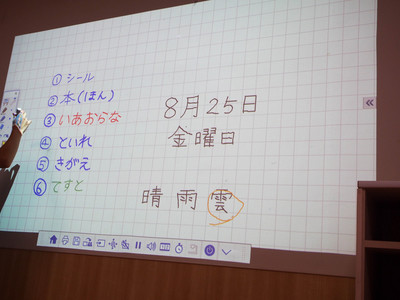
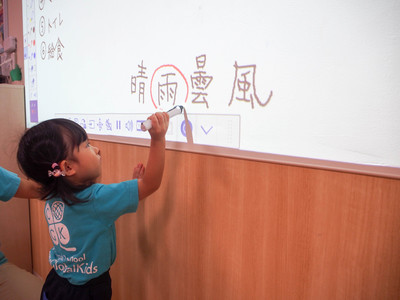
To encourage that interest, we pointed out discoveries such as the 雨 (rain) component in 曇 (cloudy), 雪 (snow) and 雷 (thunder), and the 火 (fire) in both 火曜日 (Tuesday) and 秋 (autumn). These connections brought new surprises.
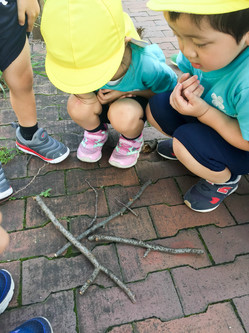
Recently, on a walk, a child in the three-year-old class found some fallen branches and said, “Look, teacher! It says 木!” Just as he said, the branches overlapped in the shape of 木, the character for tree. We had hoped the children would notice familiar kanji in books or around town, but seeing him recognize a character in the arrangement of branches was a wonderful surprise!
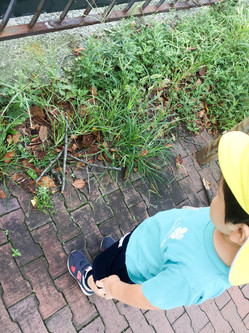
He then asked us to make 本, the character for book, and we played together using the branches to make katakana and other characters too.
Seeing children bring what they have learned into daily life and develop it in their own ways reminds us of the importance and joy of education.
Rather than asking children to read hiragana and kanji, we write dates, names and other familiar words and show them to the children to spark their interest.
One idea behind this approach is that kanji have meaning, content, shape and sound, which can make them easier for young children to picture.
At the time of this lesson, our three-year-old class was encountering familiar kanji for dates, days of the week, weather (sun, cloud, rain, wind, snow and thunder), seasons (spring, summer, autumn and winter) and daily activities (books, songs and changing clothes).
Some of these characters are more complex than those taught in the first year of elementary school. Yet the children quickly remembered them because the words were familiar and interesting to them.
To encourage that interest, we pointed out discoveries such as the 雨 (rain) component in 曇 (cloudy), 雪 (snow) and 雷 (thunder), and the 火 (fire) in both 火曜日 (Tuesday) and 秋 (autumn). These connections brought new surprises.
Recently, on a walk, a child in the three-year-old class found some fallen branches and said, “Look, teacher! It says 木!” Just as he said, the branches overlapped in the shape of 木, the character for tree. We had hoped the children would notice familiar kanji in books or around town, but seeing him recognize a character in the arrangement of branches was a wonderful surprise!
He then asked us to make 本, the character for book, and we played together using the branches to make katakana and other characters too.
Seeing children bring what they have learned into daily life and develop it in their own ways reminds us of the importance and joy of education.
Author Profile
-

-
Reiko - Services and Community Coordinator Japan

Reiko joined CGK’s founding team in 2016, bringing seven years of experience in licensed nursery schools in Japan and six years across two international preschools. She has also volunteered at a daycare in Canada and has held preschool leadership roles at CGK, including Principal and Vice Principal.
A qualified nursery teacher and holder of a Class 2 kindergarten teaching license in Japan, Reiko values each child’s interests and strengths. Drawing on her experience in multicultural early childhood settings, she supports an environment where children can explore new interests through hands-on experiences and express themselves in their own way.