











A Taste of Japanese Summer: Watermelon Fun
Preschool
July 22, 2017
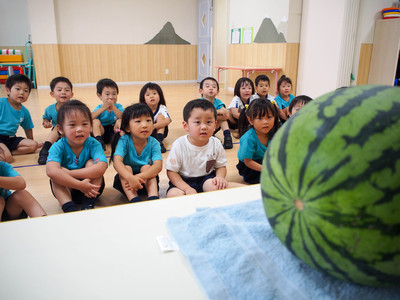
We were able to bring to life the watermelon-splitting activity we had previously discussed with the children.
A parent kindly gave us a wonderfully large watermelon. After observing it, the children tried a blindfolded pretend version of suikawari, the traditional watermelon-splitting game, and enjoyed the fruit at snack time.
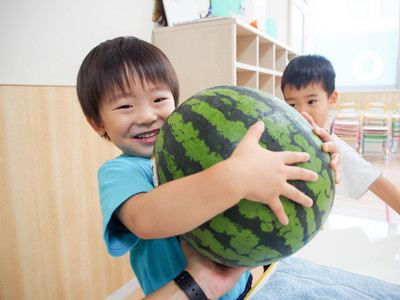
As soon as we brought it into the classroom, their eyes lit up: “A watermelon!” and “It’s huge!”
They explored its color, shape, firmness, smell and weight by touching and lifting it. They leaned back with effort as they tried to lift the heavy fruit. Smelling the rind brought another surprise: they could not smell anything from outside.
We also used photographs to explore how a seedling grows, develops buds and yellow flowers, then produces fruit. The children looked closely at the stripes on the tiny watermelon and how it gradually grew.
We had recently talked often about vegetables, and the children were interested in what foods do for their bodies. In the lesson, we described watermelon as full of water and refreshing on a hot day. They said, “We want to eat it now!”
After learning about the fruit, it was time for the game. A blindfolded child held a stick and listened to friends calling, “Straight ahead!”, “A little more!”, “Stop!” and “Hit it!” Some children were still learning that their friend could not see and called, “Toward the watermelon!” or “Over here!” It also gave us a chance to review right and left and use those directions.
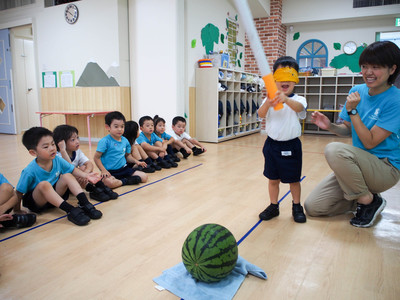
The children’s smiles shone when they successfully tapped the watermelon and took off the blindfold. Their friends giving directions looked just as happy, and the whole class enjoyed the game together.
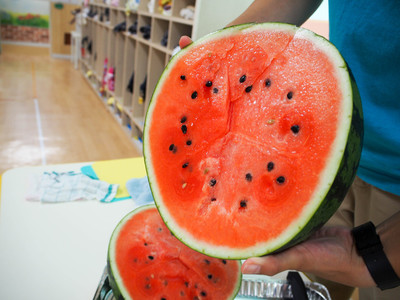
Afterward, we cut the watermelon in half to look inside.
The bright red flesh brought delighted cheers. Cutting it from different angles revealed places without seeds and others with black or white seeds, keeping the children curious.
Responding to their calls of “I want to eat it!”, we offered a taste. “Sweet!” and “Delicious!” they said.
It became a special lesson that helped us experience the summer season.
Books and photographs can teach us about watermelons, but exploring a real one with their senses gave the children a valuable hands-on experience.
A parent kindly gave us a wonderfully large watermelon. After observing it, the children tried a blindfolded pretend version of suikawari, the traditional watermelon-splitting game, and enjoyed the fruit at snack time.
As soon as we brought it into the classroom, their eyes lit up: “A watermelon!” and “It’s huge!”
They explored its color, shape, firmness, smell and weight by touching and lifting it. They leaned back with effort as they tried to lift the heavy fruit. Smelling the rind brought another surprise: they could not smell anything from outside.
We also used photographs to explore how a seedling grows, develops buds and yellow flowers, then produces fruit. The children looked closely at the stripes on the tiny watermelon and how it gradually grew.
We had recently talked often about vegetables, and the children were interested in what foods do for their bodies. In the lesson, we described watermelon as full of water and refreshing on a hot day. They said, “We want to eat it now!”
After learning about the fruit, it was time for the game. A blindfolded child held a stick and listened to friends calling, “Straight ahead!”, “A little more!”, “Stop!” and “Hit it!” Some children were still learning that their friend could not see and called, “Toward the watermelon!” or “Over here!” It also gave us a chance to review right and left and use those directions.
The children’s smiles shone when they successfully tapped the watermelon and took off the blindfold. Their friends giving directions looked just as happy, and the whole class enjoyed the game together.
Afterward, we cut the watermelon in half to look inside.
The bright red flesh brought delighted cheers. Cutting it from different angles revealed places without seeds and others with black or white seeds, keeping the children curious.
Responding to their calls of “I want to eat it!”, we offered a taste. “Sweet!” and “Delicious!” they said.
It became a special lesson that helped us experience the summer season.
Books and photographs can teach us about watermelons, but exploring a real one with their senses gave the children a valuable hands-on experience.
Author Profile
-

-
Saeda Sueki-Au-Yeung - Head of Operations / Parent Support Coordinator Japan

Saeda studied education and disability sciences in Japan and experienced winning a US collegiate national championship while studying and playing football in America. She values each child's individuality and the opportunities that come from trying new things. Through school operations and parent support, she helps families and staff work as one team to support children's growth.