










Introducing the Pygmalion Early Learning Method: Part 1
Preschool
June 5, 2017
Cosmo Global Kids introduced the Pygmalion early learning method with a dedicated visiting instructor, describing itself at the time as the first preschool in Japan to do so. Lessons began as an extracurricular class in January 2017 and joined the daytime program in April, also with a dedicated instructor.
The approach aims not simply to develop academically able children, but to nurture independent thinking. Adults can be tempted to guide children directly toward answers. As children grow into the upper elementary and junior high years, parents become less involved in teaching them, making the earlier development of independent, logical thinking important.
Pygmalion works across five areas: fine motor skills, spatial skills, shape recognition, numerical and logical thinking, and language. Its approach places particular emphasis on numerical and logical thinking.
Rather than teaching numbers only by pointing and counting “one, two, three, four,” the method presents quantities visually so children can develop a sense of how much they see. The aim is to recognize small groups of up to about five without counting each item, and to understand quantities up to ten as two smaller groups, connecting this with simple addition.
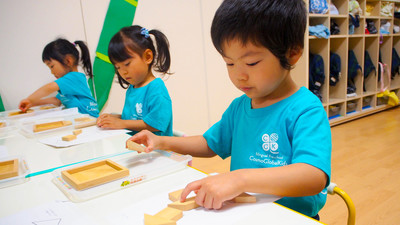
These activities also connect with spatial awareness, combining and separating groups, and learning addition.
Comparisons such as long and short and shape puzzles are other ways the method aims to develop reasoning and independent thought as foundations for later learning.
In the next article, we will introduce examples from the lessons in more detail.
Continue reading:
「Introducing the Pygmalion Early Learning Method: Part 2」
The approach aims not simply to develop academically able children, but to nurture independent thinking. Adults can be tempted to guide children directly toward answers. As children grow into the upper elementary and junior high years, parents become less involved in teaching them, making the earlier development of independent, logical thinking important.
Pygmalion works across five areas: fine motor skills, spatial skills, shape recognition, numerical and logical thinking, and language. Its approach places particular emphasis on numerical and logical thinking.
Rather than teaching numbers only by pointing and counting “one, two, three, four,” the method presents quantities visually so children can develop a sense of how much they see. The aim is to recognize small groups of up to about five without counting each item, and to understand quantities up to ten as two smaller groups, connecting this with simple addition.

These activities also connect with spatial awareness, combining and separating groups, and learning addition.
Comparisons such as long and short and shape puzzles are other ways the method aims to develop reasoning and independent thought as foundations for later learning.
In the next article, we will introduce examples from the lessons in more detail.
Continue reading:
「Introducing the Pygmalion Early Learning Method: Part 2」