










Introducing the Pygmalion Early Learning Method: Part 2
Preschool
June 10, 2017
Pygmalion lessons became part of our daytime program in April.
Please also see the preceding article:
「Introducing the Pygmalion Early Learning Method: Part 1」
Ocean class (two-year-olds) explored shapes using magnetic circles, semicircles and triangles. At the time, Cosmo Global Kids described itself as the only school in Japan starting this method with its two-year-old class from April. The children sat and listened attentively, which also surprised the visiting Pygmalion instructor.
They were exploring quantities of one and two.
Showing two cards, one with a rabbit and another with two rabbits, the teacher asked, “Which one is two?”
The lesson deliberately did not involve pointing to the rabbits and counting aloud. Its goal was not counting, but recognizing a quantity visually as a group.
To keep the activity engaging, the children held cards and blocks, or guessed about blocks hidden in the teacher’s hand. These varied approaches held their interest throughout the 30-minute lesson.
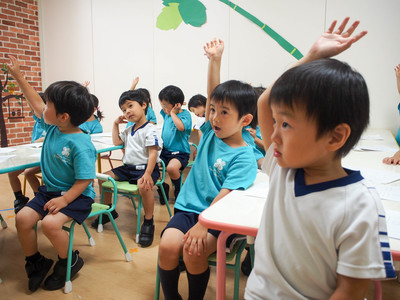
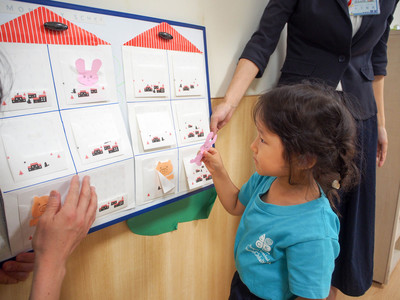
Jungle class (three-year-olds) used Tenchi puzzles to explore shapes. Some children picked up a piece and thought about where it would fit, while others looked at the target shape before choosing a piece. Both approaches involved independent thought and concentration.
Like Ocean class, they also explored quantity, from one to three, and used ropes to compare lengths and learn about positions on a flat surface.
The children looked forward to each Pygmalion lesson. After the first, one called to the instructor, “Come and play again!” Their response showed us that they experienced these lessons as enjoyable play rather than formal study.
Please also see the preceding article:
「Introducing the Pygmalion Early Learning Method: Part 1」
Ocean class (two-year-olds) explored shapes using magnetic circles, semicircles and triangles. At the time, Cosmo Global Kids described itself as the only school in Japan starting this method with its two-year-old class from April. The children sat and listened attentively, which also surprised the visiting Pygmalion instructor.
They were exploring quantities of one and two.
Showing two cards, one with a rabbit and another with two rabbits, the teacher asked, “Which one is two?”
The lesson deliberately did not involve pointing to the rabbits and counting aloud. Its goal was not counting, but recognizing a quantity visually as a group.
To keep the activity engaging, the children held cards and blocks, or guessed about blocks hidden in the teacher’s hand. These varied approaches held their interest throughout the 30-minute lesson.

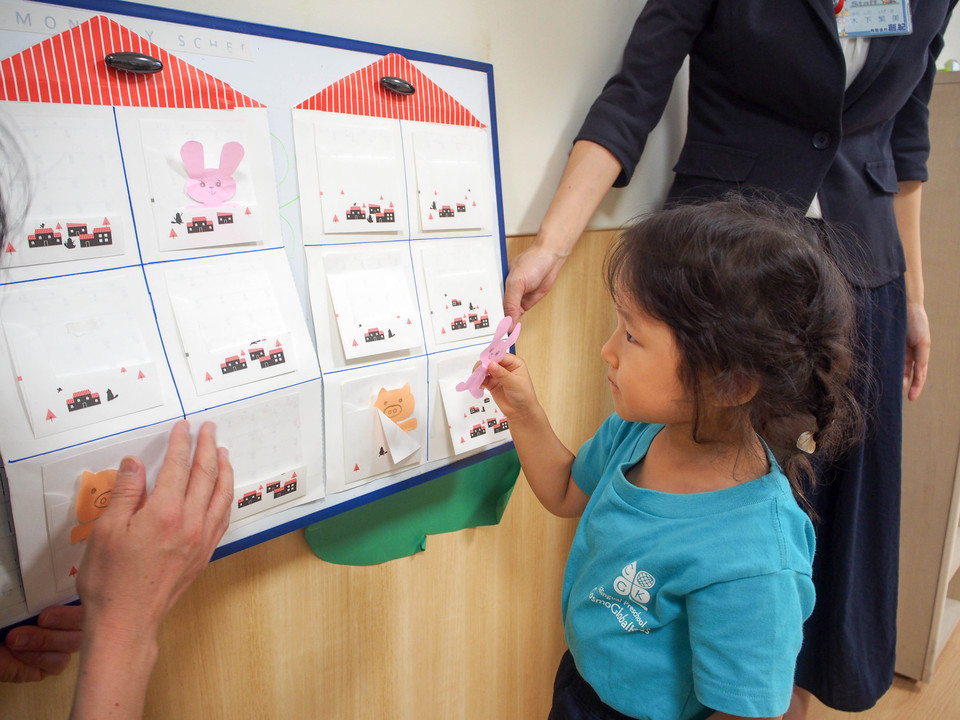
Jungle class (three-year-olds) used Tenchi puzzles to explore shapes. Some children picked up a piece and thought about where it would fit, while others looked at the target shape before choosing a piece. Both approaches involved independent thought and concentration.
Like Ocean class, they also explored quantity, from one to three, and used ropes to compare lengths and learn about positions on a flat surface.
The children looked forward to each Pygmalion lesson. After the first, one called to the instructor, “Come and play again!” Their response showed us that they experienced these lessons as enjoyable play rather than formal study.