











Food Education: Exploring the Three Color Food Groups
Preschool
May 18, 2018
At Cosmo Global Kids (CGK), our preschool offered a variety of educational programs beyond English learning.
One example was our distinctive food education program, planned together with the owner of a French restaurant.
May: Three Color Food Groups
● Ocean (age 2): learning food names and enjoying color-sorting activities.
● Jungle (age 3): exploring the different roles of foods through a quiz.
● Mountain (age 4): learning about the roles of foods and digestion.
Our food education theme for May was the Three Color Food Groups.
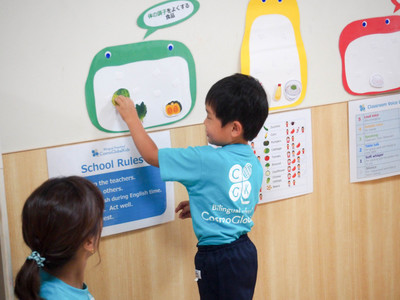
This teaching system divides foods into three groups according to their roles: red foods help build the body, yellow foods provide energy, and green foods help regulate the body’s functions. Using learning materials and quizzes, we invited children to think about which foods belong to each group.
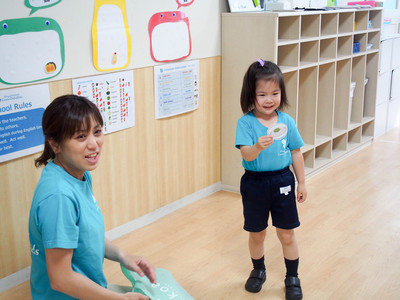
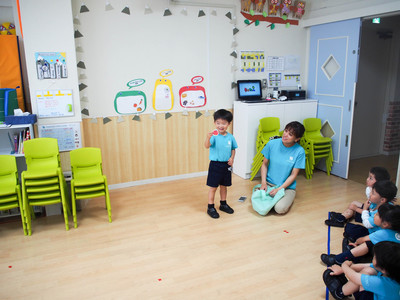
Jungle children drew food cards as though taking part in a lottery, then decided which of the three groups their ingredient belonged to.
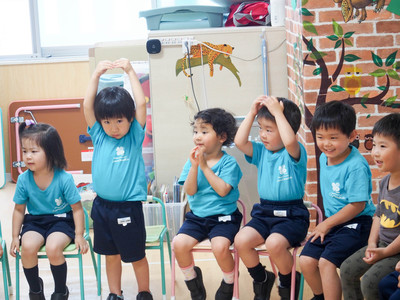
Some looked toward the teacher for reassurance before answering. When they answered correctly and their friends applauded, they looked delighted.
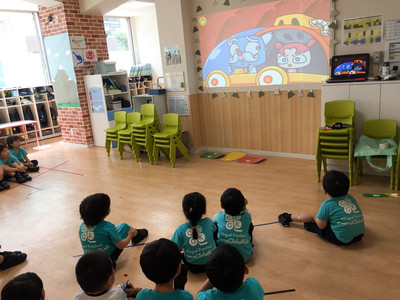
Mountain class tried the same quiz and also watched a video about digestion.
Although made for children, the video included difficult terms such as large intestine, small intestine and villi. Even without understanding everything, children repeated the unfamiliar Japanese words they heard with interest.
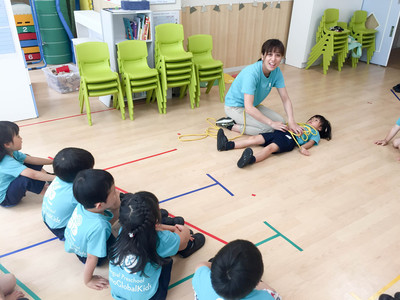
The video used three meters to describe the small intestine, so we showed that length with a skipping rope. To help children visualize how an intestine curves inside the body, one child lay on the floor and we placed the rope on their abdomen in a winding shape.
We hoped the lesson would help children understand the importance of a balanced diet for healthy growth and encourage interest not only in food but also in caring for their bodies.
One example was our distinctive food education program, planned together with the owner of a French restaurant.
May: Three Color Food Groups
● Ocean (age 2): learning food names and enjoying color-sorting activities.
● Jungle (age 3): exploring the different roles of foods through a quiz.
● Mountain (age 4): learning about the roles of foods and digestion.
Our food education theme for May was the Three Color Food Groups.
This teaching system divides foods into three groups according to their roles: red foods help build the body, yellow foods provide energy, and green foods help regulate the body’s functions. Using learning materials and quizzes, we invited children to think about which foods belong to each group.
Jungle children drew food cards as though taking part in a lottery, then decided which of the three groups their ingredient belonged to.
Some looked toward the teacher for reassurance before answering. When they answered correctly and their friends applauded, they looked delighted.
Mountain class tried the same quiz and also watched a video about digestion.
Although made for children, the video included difficult terms such as large intestine, small intestine and villi. Even without understanding everything, children repeated the unfamiliar Japanese words they heard with interest.
The video used three meters to describe the small intestine, so we showed that length with a skipping rope. To help children visualize how an intestine curves inside the body, one child lay on the floor and we placed the rope on their abdomen in a winding shape.
We hoped the lesson would help children understand the importance of a balanced diet for healthy growth and encourage interest not only in food but also in caring for their bodies.
Author Profile
-

-
Reiko - Services and Community Coordinator Japan
Reiko joined CGK’s founding team in 2016, bringing seven years of experience in licensed nursery schools in Japan and six years across two international preschools. She has also volunteered at a daycare in Canada and has held preschool leadership roles at CGK, including Principal and Vice Principal.
A qualified nursery teacher and holder of a Class 2 kindergarten teaching license in Japan, Reiko values each child’s interests and strengths. Drawing on her experience in multicultural early childhood settings, she supports an environment where children can explore new interests through hands-on experiences and express themselves in their own way.