










Food Education for Four-Year-Olds: Exploring White Ingredients
Preschool
May 2, 2018
At CGK, our preschool offers a variety of educational programs beyond English learning.
One example is our distinctive food education program, planned together with the owner of a French restaurant.
April themes
● Ocean (age 2): staying seated until the meal is finished and enjoying mealtimes.
● Jungle (age 3): table manners, including how to sit and what to avoid.
● Mountain (age 4): white ingredients—salt, sugar, flour, breadcrumbs, potato starch and baking powder.
Mountain class (age 4) explored white ingredients to build curiosity about the foods we use.
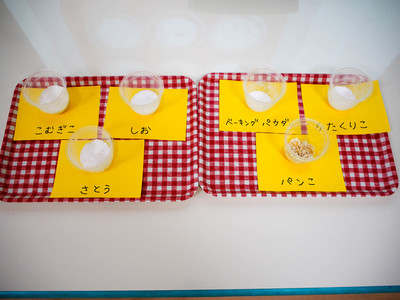
We chose six ingredients: salt, sugar, flour, breadcrumbs, potato starch and baking powder.
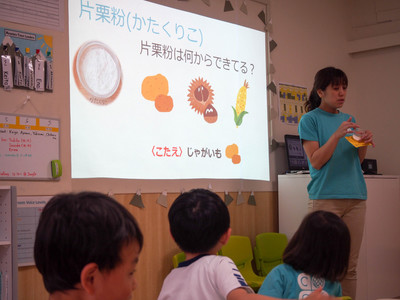
First came potato starch, an unfamiliar ingredient for many children. We asked whether it came from potatoes, chestnuts or corn. A white powder offered few visual clues, but the children looked closely and smelled it while considering their answers.
The answer was potatoes. Understanding how a potato becomes a white powder might be difficult at this stage, so we left that process for another opportunity.
We also introduced the unfamiliar Japanese word toromi, meaning thickness in a sauce. We hoped to follow up with an experiment using potato starch so children could experience the change themselves.
Next were breadcrumbs. Children readily understood that they make a fried coating crispy, but we also discussed adding them to hamburger patties. Asked what would happen, they suggested “It becomes round,” “It gets smaller,” “It sticks together” and “It tastes good.” When we explained that breadcrumbs can help make a patty softer, one girl asked, “Why does it become softer?” As teachers, it is wonderful to see children question what they hear and express their curiosity.
For baking powder, we compared photographs of pound cakes and pancakes made with and without it. Children noticed that they became bigger. We introduced another way to describe that change: rising.
Sugar was familiar and popular, but fewer children knew where it came from.
When we showed a picture of sugar beet, one child said, “A turnip!” The resemblance made sense. Its Japanese name, tensai, prompted another child to connect it with the same-sounding word for genius. Japanese words that sound alike but have different meanings can lead to delightful conversations. A picture of sugar cane brought more comparisons: burdock, tempura and spring onions.
Salt was another familiar ingredient whose original form was less familiar. Looking at a lump of rock salt, one child exclaimed, “Fried chicken!” Children’s observations are always entertaining.
We also showed sea salt and talked about why seawater tastes salty.
Finally, we explained that flour comes from wheat. Hearing the Japanese word mugi, one child told us they often drink mugicha. That connection led to a discussion of grains and grain-based drinks such as barley tea.
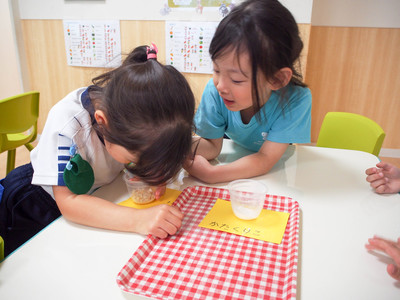
After the explanations, children examined the actual ingredients. They smelled them, shook the cups to compare sounds and noticed that some powders stuck to the sides while others did not. Some even compared grain sizes, observing that sugar grains were larger than particles of starch. Their discoveries reminded us how valuable it is to show real materials. Presenting several at once also made comparison possible, leading to new surprises and questions.

One example is our distinctive food education program, planned together with the owner of a French restaurant.
April themes
● Ocean (age 2): staying seated until the meal is finished and enjoying mealtimes.
● Jungle (age 3): table manners, including how to sit and what to avoid.
● Mountain (age 4): white ingredients—salt, sugar, flour, breadcrumbs, potato starch and baking powder.
Mountain class (age 4) explored white ingredients to build curiosity about the foods we use.
We chose six ingredients: salt, sugar, flour, breadcrumbs, potato starch and baking powder.
First came potato starch, an unfamiliar ingredient for many children. We asked whether it came from potatoes, chestnuts or corn. A white powder offered few visual clues, but the children looked closely and smelled it while considering their answers.
The answer was potatoes. Understanding how a potato becomes a white powder might be difficult at this stage, so we left that process for another opportunity.
We also introduced the unfamiliar Japanese word toromi, meaning thickness in a sauce. We hoped to follow up with an experiment using potato starch so children could experience the change themselves.
Next were breadcrumbs. Children readily understood that they make a fried coating crispy, but we also discussed adding them to hamburger patties. Asked what would happen, they suggested “It becomes round,” “It gets smaller,” “It sticks together” and “It tastes good.” When we explained that breadcrumbs can help make a patty softer, one girl asked, “Why does it become softer?” As teachers, it is wonderful to see children question what they hear and express their curiosity.
For baking powder, we compared photographs of pound cakes and pancakes made with and without it. Children noticed that they became bigger. We introduced another way to describe that change: rising.
Sugar was familiar and popular, but fewer children knew where it came from.
When we showed a picture of sugar beet, one child said, “A turnip!” The resemblance made sense. Its Japanese name, tensai, prompted another child to connect it with the same-sounding word for genius. Japanese words that sound alike but have different meanings can lead to delightful conversations. A picture of sugar cane brought more comparisons: burdock, tempura and spring onions.
Salt was another familiar ingredient whose original form was less familiar. Looking at a lump of rock salt, one child exclaimed, “Fried chicken!” Children’s observations are always entertaining.
We also showed sea salt and talked about why seawater tastes salty.
Finally, we explained that flour comes from wheat. Hearing the Japanese word mugi, one child told us they often drink mugicha. That connection led to a discussion of grains and grain-based drinks such as barley tea.
After the explanations, children examined the actual ingredients. They smelled them, shook the cups to compare sounds and noticed that some powders stuck to the sides while others did not. Some even compared grain sizes, observing that sugar grains were larger than particles of starch. Their discoveries reminded us how valuable it is to show real materials. Presenting several at once also made comparison possible, leading to new surprises and questions.
Author Profile
-

-
Reiko - Services and Community Coordinator Japan
Reiko joined CGK’s founding team in 2016, bringing seven years of experience in licensed nursery schools in Japan and six years across two international preschools. She has also volunteered at a daycare in Canada and has held preschool leadership roles at CGK, including Principal and Vice Principal.
A qualified nursery teacher and holder of a Class 2 kindergarten teaching license in Japan, Reiko values each child’s interests and strengths. Drawing on her experience in multicultural early childhood settings, she supports an environment where children can explore new interests through hands-on experiences and express themselves in their own way.