










Little Scientists: Exploring Planets, Ice and Unexpected Results
At CGK, Job Training focused on one profession each month. It was one of the ways we incorporated active learning into our educational approach.
Our science themes that month were planets and ice.
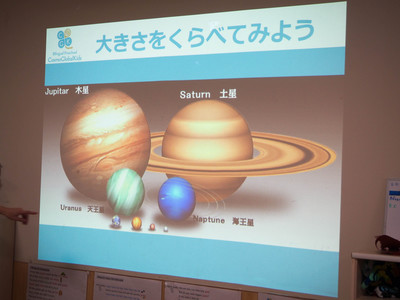
While learning the English names of planets, children also explored their characteristics. Expressions such as “hottest” and “larger” introduced comparatives and superlatives, bringing new language together with science.
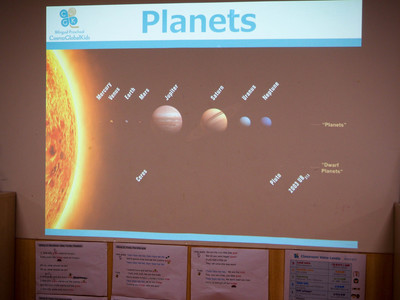
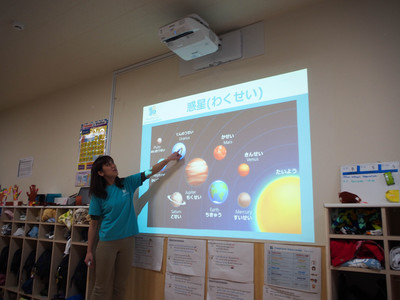
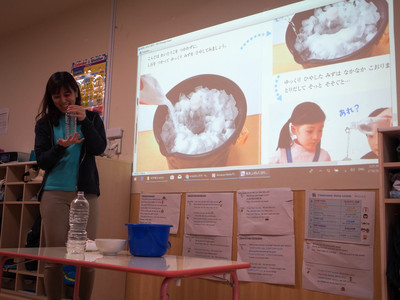
During Japanese time, we used a projector to compare planetary temperatures and learn about the inside of the Earth.
For our ice activities, we froze acorns, other natural objects and flowers in trays and played with the results outdoors. A nature picture book about ice inspired an experiment placing a ten-yen coin against ice. When children wanted to know whether the ice would float, we tried putting it into a bucket of water. They enjoyed pursuing their own questions.
The same book also inspired an experiment with supercooling.
We placed a bottle of water in a bucket filled with ice and salt to cool it gradually. White frost began forming around the bucket, and anticipation grew.
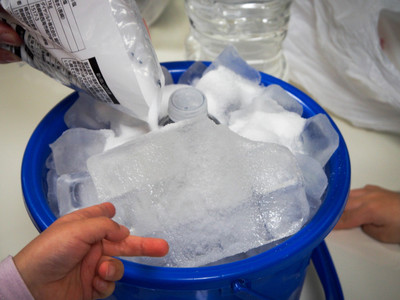
Finally, it was time to watch the water turn to ice as we poured it!
…
But wait—it did not happen…
The poured water remained liquid, while some water inside the bottle had already frozen. We thought movement while removing the bottle may have triggered the freezing too early.
One child said, “It failed,” but another encouraged us: “It is okay to make mistakes, teacher.” We had hoped to see a tower of ice form as we poured. Instead, we took out the ice that had formed inside the bottle and examined it. It was soft, and the children eagerly touched it and explored its texture.
Although the experiment did not work as planned, we felt that an experience like this could be useful too.
An unexpected result gives us a reason to ask why, discover something new and plan another attempt. It is not wasted learning.
We hope to use what we learned and try again!
Supercooling describes a substance remaining in its existing state below the temperature at which a phase change would normally occur. For example, a liquid may cool below its freezing point without becoming solid. For water, this means remaining liquid below 0°C.
Source quoted in the original article: Supercooling – Wikipedia
Author Profile
-

-
Reiko - Services and Community Coordinator Japan
Reiko joined CGK’s founding team in 2016, bringing seven years of experience in licensed nursery schools in Japan and six years across two international preschools. She has also volunteered at a daycare in Canada and has held preschool leadership roles at CGK, including Principal and Vice Principal.
A qualified nursery teacher and holder of a Class 2 kindergarten teaching license in Japan, Reiko values each child’s interests and strengths. Drawing on her experience in multicultural early childhood settings, she supports an environment where children can explore new interests through hands-on experiences and express themselves in their own way.