











Learning Perseverance from the PyeongChang 2018 Olympics
Preschool
February 22, 2018
The PyeongChang Olympics were taking place when this article was written.
We had not originally planned an Olympic lesson. However, during the previous week’s melodica practice, some Jungle children (age 3) became upset or gave up when playing was difficult. We decided to introduce Olympic athletes as examples of perseverance.
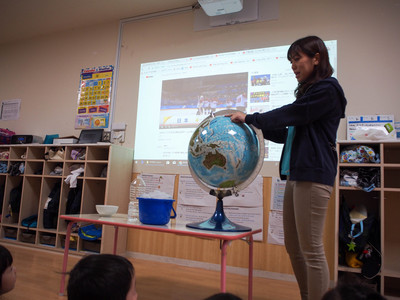
We watched snowboarding and ice hockey, a sport the children had already encountered in intercultural learning about Canada. The big snowboard jumps prompted excited cries of “I saw this at home!” and “Amazing!” When hockey appeared, children happily called out “Ice hockey!” in clear English. Although it might otherwise have been an unfamiliar sport, their earlier learning made it feel close to them.
After the videos, we discussed how hard the athletes had practiced. When something was difficult, they had not only cried, “I cannot do it,” but thought about how to improve and made an effort. We deliberately introduced the more challenging Japanese word doryoku, meaning effort or perseverance, because we thought it would capture the children’s interest.
They listened seriously and said they would practice hard to improve.
Later, while changing from PE clothes into uniforms, one child responded to praise for being quick by proudly saying, “Yes! I am making an effort.” The idea had already made an impression.
Every child has strengths and difficulties, and we do not expect them to excel at everything. But when they set their own goal or decide something matters to them, we hope to nurture the resilience to keep trying.
We had not originally planned an Olympic lesson. However, during the previous week’s melodica practice, some Jungle children (age 3) became upset or gave up when playing was difficult. We decided to introduce Olympic athletes as examples of perseverance.
We watched snowboarding and ice hockey, a sport the children had already encountered in intercultural learning about Canada. The big snowboard jumps prompted excited cries of “I saw this at home!” and “Amazing!” When hockey appeared, children happily called out “Ice hockey!” in clear English. Although it might otherwise have been an unfamiliar sport, their earlier learning made it feel close to them.
After the videos, we discussed how hard the athletes had practiced. When something was difficult, they had not only cried, “I cannot do it,” but thought about how to improve and made an effort. We deliberately introduced the more challenging Japanese word doryoku, meaning effort or perseverance, because we thought it would capture the children’s interest.
They listened seriously and said they would practice hard to improve.
Later, while changing from PE clothes into uniforms, one child responded to praise for being quick by proudly saying, “Yes! I am making an effort.” The idea had already made an impression.
Every child has strengths and difficulties, and we do not expect them to excel at everything. But when they set their own goal or decide something matters to them, we hope to nurture the resilience to keep trying.
Author Profile
-

-
Reiko - Services and Community Coordinator Japan
Reiko joined CGK’s founding team in 2016, bringing seven years of experience in licensed nursery schools in Japan and six years across two international preschools. She has also volunteered at a daycare in Canada and has held preschool leadership roles at CGK, including Principal and Vice Principal.
A qualified nursery teacher and holder of a Class 2 kindergarten teaching license in Japan, Reiko values each child’s interests and strengths. Drawing on her experience in multicultural early childhood settings, she supports an environment where children can explore new interests through hands-on experiences and express themselves in their own way.