











Food Education for Three-Year-Olds: Table Manners
Preschool
May 1, 2018
At CGK, our preschool offers a variety of educational programs beyond English learning.
One example is our distinctive food education program, planned together with the owner of a French restaurant.
April themes
● Ocean (age 2): staying seated until the meal is finished and enjoying mealtimes.
● Jungle (age 3): table manners, including how to sit and what to avoid.
● Mountain (age 4): white ingredients—salt, sugar, flour, breadcrumbs, potato starch and baking powder.
Jungle class (age 3) learned about table manners, including how to sit in a chair and behaviors to avoid.
Having moved up from the youngest class, the children were very conscious of being older now that a new younger group had joined the school. “We are Jungle now!” was a source of pride.
We wanted to build on that awareness by carefully introducing mealtime habits, including how to sit.
Through questions and demonstrations, we discussed helpful and unhelpful ways of sitting, not only at mealtimes.
When a teacher sat too far from the table, children eagerly called out, “No! You will spill!” Some could explain not just that something was wrong, but why.
We also discussed not spending the whole meal chatting, not swinging our legs or playing with dishes, and always putting a chair back when leaving the table. These were habits we wanted even our three-year-olds to begin practicing.
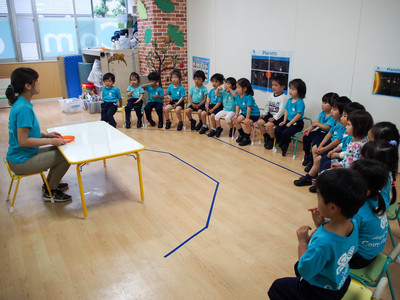
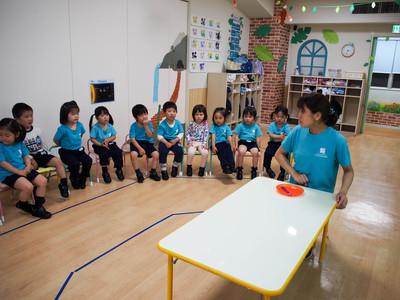
At the end, small groups came to the front for role-play. Being watched by friends brought a little nervousness, along with opportunities to praise good examples and help one another notice what to improve.
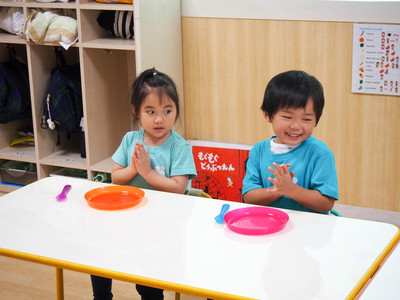
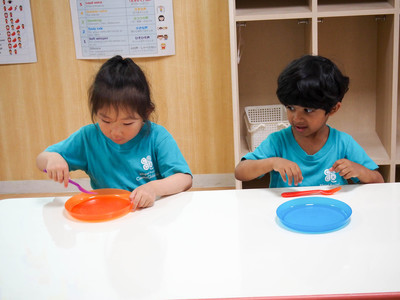
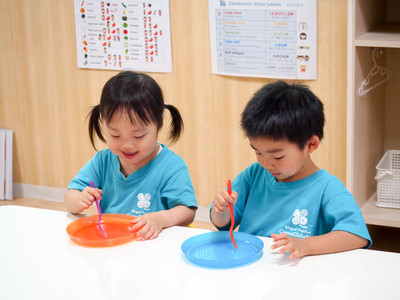
Enjoying food is very important. As children grow, learning considerate manners matters too. We will continue supporting both so everyone can enjoy mealtimes together.
One example is our distinctive food education program, planned together with the owner of a French restaurant.
April themes
● Ocean (age 2): staying seated until the meal is finished and enjoying mealtimes.
● Jungle (age 3): table manners, including how to sit and what to avoid.
● Mountain (age 4): white ingredients—salt, sugar, flour, breadcrumbs, potato starch and baking powder.
Jungle class (age 3) learned about table manners, including how to sit in a chair and behaviors to avoid.
Having moved up from the youngest class, the children were very conscious of being older now that a new younger group had joined the school. “We are Jungle now!” was a source of pride.
We wanted to build on that awareness by carefully introducing mealtime habits, including how to sit.
Through questions and demonstrations, we discussed helpful and unhelpful ways of sitting, not only at mealtimes.
When a teacher sat too far from the table, children eagerly called out, “No! You will spill!” Some could explain not just that something was wrong, but why.
We also discussed not spending the whole meal chatting, not swinging our legs or playing with dishes, and always putting a chair back when leaving the table. These were habits we wanted even our three-year-olds to begin practicing.
At the end, small groups came to the front for role-play. Being watched by friends brought a little nervousness, along with opportunities to praise good examples and help one another notice what to improve.
Enjoying food is very important. As children grow, learning considerate manners matters too. We will continue supporting both so everyone can enjoy mealtimes together.
Author Profile
-

-
Reiko - Services and Community Coordinator Japan

Reiko joined CGK’s founding team in 2016, bringing seven years of experience in licensed nursery schools in Japan and six years across two international preschools. She has also volunteered at a daycare in Canada and has held preschool leadership roles at CGK, including Principal and Vice Principal.
A qualified nursery teacher and holder of a Class 2 kindergarten teaching license in Japan, Reiko values each child’s interests and strengths. Drawing on her experience in multicultural early childhood settings, she supports an environment where children can explore new interests through hands-on experiences and express themselves in their own way.