










How to Choose a Preschool in Japan: Curriculum, Hours and Language Support
The original article observed increasing interest in early English education and more media coverage of the subject.
Extracurricular English lessons and English-medium afterschool care are familiar options, while some families choose a 「preschool」 from around eighteen months or two years old.
Here we explore what a preschool offers and the questions that can help families compare schools.
What Is a Preschool?
As the related article explains, in Japan a preschool often means an English-medium childcare or kindergarten setting.
Many are registered with their municipality as ninkagai childcare facilities, outside the licensed nursery system.
In this article, “preschool” is used as a practical description rather than a separate legal school category.
First, let us look at the historical context of preschools and early English education in Japan.
The Preschool Sector
For a concrete example of learning in practice, explore IB inquiry in our four-year-old class.
Changes in the Number of Preschools in Japan
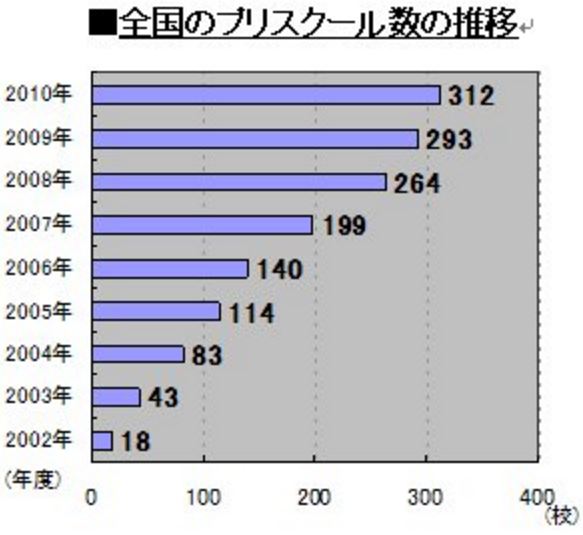
Source cited in the original article: ALC, Children’s English Catalogue 2010
The chart presents historical preschool numbers.
The cited survey counted eighteen schools in 2002, with around thirty or more added annually, reaching 312 schools in 2010.
The original article inferred that the number had subsequently risen alongside market growth. These historical figures are not a verified current school count.
Growth of the Preschool Market
The original article cited Yano Research Institute’s 2015 and 2022 surveys of the language-business market. It reported preschool-market revenue of ¥29.8 billion in fiscal 2013 and ¥40 billion in fiscal 2021.
The author interpreted growth despite a falling child population as a sign of greater interest in early English education. This is an interpretation, not proof of the cause.
The article highlighted this growth even though fees at these predominantly ninkagai settings can be relatively high.
What Kind of English Education Is Provided?
The article contrasts immersion-based preschools with settings where a visiting English teacher offers a few sessions each month to introduce English. In an English-medium preschool, most or all everyday care and learning take place through English.。
Many use an approach known as English immersion, in which children spend much of their day using English.
Young children can learn through repeated, meaningful interaction. However, exposure alone does not tell you whether a school offers a coherent educational experience. Ask whether the programme has a planned curriculum and whether the preschool can explain how activities build on one another.
If English development is one of your priorities, the following questions can help you look beyond the school’s label.
Choosing a Preschool: An English-Education Perspective
A preschool choice begins with your family’s priorities for early language learning.
The following points reflect the author’s preference for a consistent, full-day curriculum. Use them as questions for comparison rather than a universal ranking of schools.
Different children and families may benefit from different schedules. English provision is only one part of a school’s quality.
Two or Three Days a Week, or Five? The Author’s Preference Is a Consistent Five-Day Programme
Some families need part-time attendance. When continuity of an English-medium curriculum is the main priority, the author recommends five days from Monday to Friday.
If children attending two days and five days share the same programme, attendance and prior learning can differ considerably. Teachers must plan for changing groups, varied experiences and participation in events. This can make a coherent programme more demanding to deliver and may require more flexible lesson planning. It does not mean that every part-time programme is lower quality; ask how the school manages these differences.
From a care perspective, regular time together can also give teachers more opportunities to observe and support each child’s development.
Short Days Ending Around 2:00pm, or Full Days? The Author’s Preference Is Full-Day Provision
As with part-time attendance, shorter daily hours involve decisions about how to fit in outdoor play as well as rest and naps、 and physical activity. A full-day programme, for example until 5:00pm, has more time for these experiences. Suitability still depends on the child and the quality of the routine.
How Are Both Languages Supported? Understanding the Original “Semilingualism” Discussion
The original article raised a concern that an entirely English school day might leave insufficient support for Japanese. It also suggested this could affect the language foundation for thinking. Editorial clarification: bilingualism itself does not cause a language disorder or an inability to reason. See ASHA’s multilingual-development guidance.
The older term “semilingualism” or “double-limited” was used in the source to describe concern about insufficient development in both languages, including in preschools and international schools. It should not be used to diagnose a child from their school language or to imply that learning two languages is harmful.
The author emphasised communicating richly in Japanese at home and described this as generally reassuring. Supporting the family’s languages is valuable, but individual developmental concerns should be assessed professionally rather than dismissed with a guarantee.
Some preschools also provide Japanese education, including CGK International School, for reasons such as:
Conclusion
The original article noted many two- or three-day and short-day options, while preschools offering five full days from morning to late afternoon, such as CGK International School, were described as less common both in Naka Ward, Yokohama and more widely in Japan. This was the author’s observation at the time.
As families’ needs vary, including households with a parent at home and households with working parents, a range of preschool models will remain important. Look for a school that can explain how its curriculum, care and schedule fit your child and your family.
Author Profile
-

-
Minoru Kai - School Founder, CGK International School Japan

Born in 1984, father to two children.
After residence and stay in Australia, Canada and America, worked at an advertising agency concurrently in overseas exhibition work and domestic advertising work.
He also founded CGK International School (Yokohama) from scratch and provides management consulting for international schools.