










What Is a Preschool in Japan? How It Differs from an International School
The original article described early English education as a growing market and anticipated further growth despite Japan’s declining birth rate. It argued that language education would play an important role in Japan’s international future. These are the author’s observations and expectations, not a current market forecast.
For children below elementary-school age, English learning options extend beyond extracurricular lessons to preschools and international schools.
Because these labels are often used interchangeably, let us look at what each can mean.
What Is a Preschool?
Preschool is a familiar term to many parents and educators, but its meaning is not always obvious to people outside early childhood education.
The Japanese term comes from the English word "preschool" itself.Kindergartens and nursery schools are related concepts. The English dictionary description quoted below describes a school for young children:
preschool
a school for children between the ages of about two and five
Oxford Advanced Learner's Dictionary
This refers broadly to education before elementary school, often around ages two to five. The original article also mentioned a three-to-five age range in Wikipedia. Exact ages, names and arrangements differ between countries and regions.
Preschool in the United States
In many US school systems, the year around ages five to six before first grade is called "Kindergarten".
Before that, families may encounter "Pre-kinder" or "Preschool". In the example used here, pre-kindergarten serves children around age four、preschool serves children around ages two to four. These are illustrative age ranges, not a nationwide admission rule.
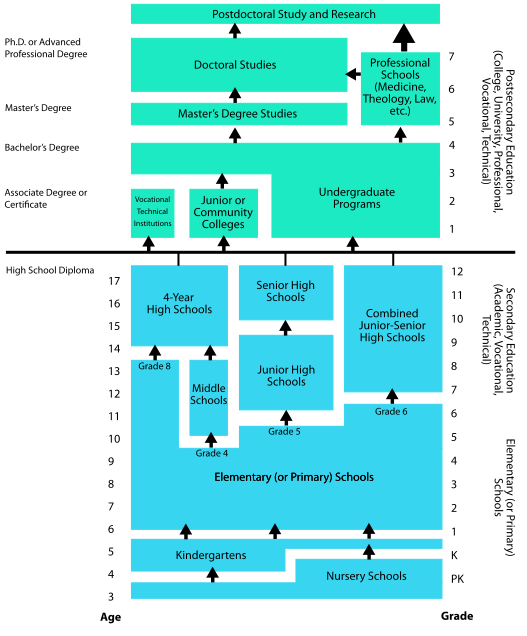
The diagram below illustrates the original comparison. It groups preschool within nursery provision; the names and ages used by individual institutions vary.
Preschool in Japan
In Japan, “preschool” often means an English-medium kindergarten or childcare setting.
Unlike a weekly English lesson, this environment gives children opportunities to use English in everyday situations.
Early English learning and English immersion are combined. The original article also discussed concerns described as “semilingualism” or “double-limited” language development. Editorial clarification: learning two languages does not itself cause a language disorder or an inability to think logically. The original wording should not be read as a diagnosis or a prediction. Rich interaction in the languages used by the family is valuable; individual developmental concerns should be discussed with a qualified professional. See ASHA’s guidance on learning more than one language.
Preschool schedules vary. Some offer two to five days a week until around 2:00pm, while others provide extended care five days a week into the late afternoon.
Some full-day preschools provide Japanese as well as English education. Supporting both languages is useful for reasons beyond the concern discussed in the original article.
Children can encounter different customs and cultures through English while also learning about Japanese routines, manners, cooperation and community life through Japanese. These experiences support broader development and can help with the transition to a Japanese elementary school.
Purīsukūru, Puresukūru, Puri and Pure
Purīsukūru comes from “preschool.” Its English pronunciation is closer to purīsukūru than the alternative Japanese rendering puresukūru, but both generally refer to the same thing.
The original article noted that purīsukūru was the more common spelling.
- Monthly Google search estimates quoted in the original article for purīsukūru: 8,100 in August 2022 (3,600 in August 2021).
- For puresukūru: 2,400 in August 2022 (1,600 in August 2021). These historical estimates are not current search-volume measurements.
Some people also say puri or pure, simply abbreviating purīsukūru or puresukūru.
What Is an International School? What Does “Inter” Mean?
「International school」 is a term with a longer history in Japan.
Common past perceptions included:
- Schools mainly for Japanese returnee children and families relocating to Japan from abroad
- Schools that did not accept children whose parents were both Japanese
These were perceptions, not rules applying to every school.
More recently, people have also associated them with:
- The children of well-known people and prominent graduates, such as Hikaru Utada
- Japan-born children from Japanese-speaking families whose parents want them to grow up bilingual
International schools can include elementary, middle and high school. Here, however, we compare the early-childhood sections of international schools with preschools specifically.
※“Inter” is a Japanese abbreviation for “international school”, much like puri and pure are abbreviated school labels.
※For international schools from elementary age onward, see the following article.
How Do Preschools and International Schools Differ?
Their historical backgrounds help explain the distinction drawn in the original article. Individual schools do not necessarily fit these categories.
International Schools
- International schools have a longer history in Japan.
- Traditionally, many were intended less as English courses and more as schools for children already using English as a home language.
- Rather than teaching English solely as a foreign language, they teach subjects through English.
- They can provide continuity for children who have lived abroad or are unfamiliar with Japanese language and school routines.
- Some expect parents to communicate in English because procedures and documents are in English.
Preschools
- English-medium preschools in Japan were described in the original article as a newer sector, with roughly twenty years of history at that time.
- Many have served children who do not speak English at home, including Japanese-speaking families seeking an English-learning environment.
- The original article described strong demand and a growing number of schools.
Summary
Historically, the article distinguished provision aimed at overseas or returnee families from provision aimed at Japanese-speaking families. However, many preschools also describe themselves as “international schools”, so the names increasingly overlap and do not reliably identify a school’s admissions policy or curriculum.
What Is an International Preschool?
This combined label can be especially confusing.
“Is it a preschool or an international school?”
Schools from either of the categories discussed above may use “international preschool.” The name alone does not settle the question.
Because an “international school” may also include elementary and secondary sections, the term “international preschool” can simply specify its early-childhood provision.
Conclusion
Today, preschools and international schools cannot reliably be distinguished by name alone. Read their websites, visit, observe the children’s activities and ask about how the school works.
When comparing English-medium childcare and education, look carefully at the attention given to both care and learning.
When comparing schools, look beyond their names to the learning itself. Here is an IB lesson in which four-year-olds explore animals and the environment.
We hope these distinctions help you make a thoughtful choice for your child in an increasingly varied education landscape.
Author Profile
-

-
Minoru Kai - School Founder, CGK International School Japan
Born in 1984, father to two children.
After residence and stay in Australia, Canada and America, worked at an advertising agency concurrently in overseas exhibition work and domestic advertising work.
He also founded CGK International School (Yokohama) from scratch and provides management consulting for international schools.